Saturday, September 30, 2006

Venezuela asks U.N. to act against Cuban militant Posada Carriles

Venezuela said Thursday that it has asked the U.N. Security Council for help in its demands that the United States hand over a Cuban militant accused of planning the 1976 bombing of a Cuban airliner.


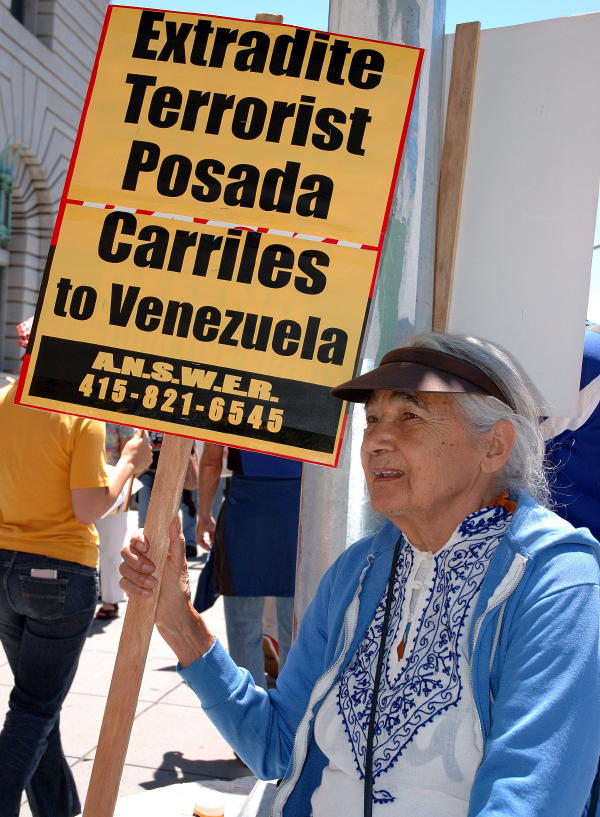
Foreign Minister Nicolas Maduro said that his government is asking the Security Council to take action against Luis Posada Carriles, a militant foe of Cuban leader Fidel Castro who is wanted in Venezuela for allegedly plotting in Caracas the attack on the passenger flight that killed 73 people.

"We came to ask the Security Council that it take part in the affair and to ask that U.S. public opinion react to the (U.S. government's) protection of this dangerous terrorist," Maduro told reporters at the seat of the U.N. in New York.

Posada Carriles, 77, a former CIA operative, has been jailed since May 2005 after entering the United States illegally. Maduro reiterated Venezuela's demands that Posada Carriles, who is a Cuban-born naturalized Venezuelan citizen, be extradited to face charges of homicide and treason in the South American country.

"We hope that ... 30 years after the blowing up of the Cubana de Aviacion flight that there is justice (and that) Posada Carriles is extradited," Maduro said.

A U.S. federal magistrate ruled earlier this month that Posada Carriles should be released pending his deportation to any country but Cuba or Venezuela, where the U.S. says he could be tortured.

Source

How ironic that the US do not want one of their own CIA employees taken anywhere and 'tortured'. It seem that the only 'terrorists' that they wish to be tortured are those that they 'claim' are a threat to the United States . The other terrorists, who simply plant bombs on passenger planes killing Woman and Children on behalf of the CIA do not qualify.

It is clear that the US does make a distinction between the 'terrorists' and those that harbour them when such terrorists were found to be working for the CIA at the time of their pre planned slaughter of innocents.

Hypocrisy is alive and well it seems.

Monday, April 09, 2007

Cuba slams US’ double standard on terrorism

Cuba yesterday slammed what it said was the US’ double standard on terrorism after a US federal judge ordered the release of an anti-Castro activist convicted in the deadly downing of a Cuban jet.

“The court ruling is yet another confirmation of the George W. Bush administration’s double standard on its alleged war on terror,” the Cuban Communist Party newspaper Granma said.

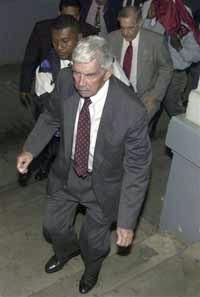
The ruling by a federal judge in Texas, does not necessarily mean former CIA operative Luis Posada Carriles, 79, will leave jail immediately, since he could be arrested by US immigration officials who have a deportation order for him. On Friday he was ordered freed pending a hearing on immigration fraud charges.

The US judge ordered the Cuban-born Venezuelan national released on $350,000 on condition that he remain confined to his Miami home and submit to “electronic monitoring,” according to the text of the order by the federal court in El Paso, Texas.

Posada Carriles, a fierce opponent of communist Cuban leader Fidel Castro, was accused of masterminding the downing of a Cuban jet off Barbados in 1976 in which 73 people were killed. He was detained in Venezuela in 1976 and convicted in the case, but fled prison in 1985.

Continue reading at the Source.

Previous articles about Luis Posada carriles can be found Here.

Wednesday, September 13, 2006

Nonaligned want terrorism redefined

Iran, Syria, North Korea and more than 100 other nations are pushing to broaden the world's definition of "terrorism" to include the U.S. occupation of Iraq and the Israeli invasion of Lebanon.


Converging on Fidel Castro's communist Cuba for a summit this week, members of the Nonaligned Movement complain of a double standard: powerful nations like the United States and Israel decide for the world who the terrorists are, but face no punishment for their own acts of aggression.

A draft of the group's joint declaration condemns "terrorism in all its forms," especially violence that targets civilians.

Terrorism should not be associated with any religion or nationality, says the draft. It singles out a favored phrase of President Bush in declaring that member countries "totally reject the use of the term 'axis of evil' by a certain state to target other states under the pretext of combating terrorism."

A Cuban official said sarcastically on Tuesday that the U.S. could one day accuse the entire Nonaligned Movement of supporting terrorism. "Reading some news reports ... I'm left to believe that the axis of evil is growing," said Abelardo Moreno, Cuba's vice foreign minister. "Soon, the (axis of evil) will be made up of 118 countries."

Cuba says the U.S. is particularly hypocritical in the case of a former CIA operative and Castro foe wanted in Venezuela in the 1976 bombing of a Cuban jetliner from Caracas that killed 73 people.

On Monday, as the U.S. sought global support for its response to the Sept. 11 attacks five years ago, a federal magistrate in Texas said Luis Posada Carriles should be released while he waits to be deported anywhere but Cuba or Venezuela, where the U.S. fears he could be tortured.

Source

Tuesday, February 28, 2006

Should Cuba Bomb the United States?

The United States appears to spare no effort in its “war against terrorism.” It has even violated the territory of Pakistan, one of its most faithful allies, and killed its people.


On January 13, 2006, the CIA launched several missiles from a pilotless plane over the Pakistani town of Damadola, 50 kilometers from the Afghan border. The air strike caused a real slaughter: three houses were destroyed and 18 civilians lost their lives, including at least three children and five women, not to mention the numerous injured.

According to the US authorities the murderous aggression launched against that population was targeted at Al Qaeda’s number two man, Ayman al-Zawahiri, an Egyptian-born man who was supposed to be attending a dinner there.

Notwithstanding, Islamabad formally expressed its dissatisfaction, saying that the United States had missed its target. In fact, the body of the Al Qaeda leader was not found among the debris and the local authorities also certified that all the victims were inhabitants of the town.

Pakistan's Prime Minister, Saukhat Aziz, deplored the attack, which came from Afghanistan. This a totally condemnable act," he affirmed, although his statement only sought to calm the people's anger.

Actually, the PM refused to cancel George H. Bush's visit, because although the incident was reprehensible, one must not forget that "Pakistan needs investments," he added.

For his part, Shafqat Mahmood, a former senator, who favors the war against terrorism, stated that the new atrocities exacerbated people's bitterness against the United States. "There is a widespread resentment about Pakistan's territory being violated by an ally. We have been fervent allies in the war against terror, and if our territory is struck, this will obviously create a problem," he said.

The Pakistani media severely chastised the military action against civilians. "The attack would have also been unjustified even if it had hit the targets aimed at," said an editorial by the English-speaking newspaper “The News”, which noted that the action would only inflame animosity towards the United States. Thousands of people demonstrated in Karachi, on January 15, 2006 to protest against the lethal bombing, which had followed another one against Pakistani tribal regions a few days before, taking the lives of at least eight people.

Secretary of State Condoleezza Rice, defended the destructive strategies that are being used by the CIA and refused to present her apology for the "collateral damage." "It is not convenient to treat terrorists softly," said Rice. In her opinion, it is totally legitimate to bomb any place that shelters people involved in international terrorism.

If one follows the US logic, then what attitude should Cuba adopt, having been the first victim of international terrorism nearly a half century ago? Should it bomb the "residence" where Luis Posada Carriles is currently living, in El Paso, Texas? Should it launch a missile against Orlando Bosch's house in Miami?

Both men are responsible, among other crimes of the killing of 73 people in the mid-air bombing of a Cuban airliner, on October 6 1976, and they are now enjoying total impunity.

Source : Here

Thursday, December 01, 2005

America's double standard on terrorism

Source : Here

Cuban expatriate Luis Posada Carriles, an old U.S. terrorist chicken, has come home to roost in Bush's nest, exposing the president's anti-terrorist policies as a hoax.


Posada, 77, unabashedly embodies violence as Gandhi stood for nonviolence. His resume contains a long list of terrorist "accomplishments," including the bombing of a Cuban commercial airliner over Barbados in which all 73 people aboard died.

Yet this year he returned surreptitiously to the United States, where he had not resided regularly since the mid 1960s. After reports of his presence began to embarrass Homeland Security, he turned himself in and requested political asylum. Because U.S. judges and the government have refused to extradite him to Venezuela to face charges to the crimes he admits to having committed, he's likely to be allowed to live freely and legally in this country within a few months.

His return to the U.S. in the midst of the President's war against terrorism embarrasses the Bush administration. Posada has forced it to decide on terrorist criteria: "acceptable" acts of terrorism carried out against Cuba versus unacceptable ones undertaken against the United States and its allies.

It is indeed a double standard. And it puts these comments Mr. Bush made in a recent speech in an awkward light: "The United States makes no distinction between those who commit acts of terror and those who support and harbor them, because they're equally as guilty of murder."

Posada has confided to journalists and others that for four decades he had worked on and off with the CIA to assassinate Cuban President Fidel Castro. In 1976, Posada teamed up with Orlando Bosch, another obsessed Castro-hater, and hired two Venezuelan killers to detonate a bomb on board a commercial Cubana flight over Barbados.

Seventy-three passengers and crew members died. This was a blatant terrorist act. The hired weasels ratted on Posada to the police, landing him in a Venezuelan prison.

After a decade of inconclusive judicial proceedings, Posada's Miami buddies bribed the prison officials and Posada "escaped" to Central America, where he worked for Lt. Col. Oliver North in supplying the Contras in their CIA-backed attempt to overthrow the Nicaraguan government.

In 1990 in Guatemala, an unknown gunman shot Posada in the face. He recovered, but didn't regain full use of his voice. Even that didn't stop him. In 1997, he recruited a Salvadoran to bomb hotels in Cuba. One bomb killed an Italian tourist. Cuban cops grabbed the Salvadoran, who named Posada as his employer
.

Posada even boasted about his violence against Cuban tourism to two New York Times reporters in July 1998. How did he feel about killing the innocent civilian, they asked? "I sleep like a baby," he replied. In 1999, beginning to feel age and frustration as the ever elusive Castro still rode high, Posada planned another hit. With three seasoned assassins, he traveled to Panama with explosives that he planned to detonate under the platform where Castro would be speaking. Again, someone informed the police.

He and his cronies got caught, tried and convicted — but not of conspiring to assassinate. Rather, with Miami money pulling Panamanian judicial strings, a judge found them guilty of threatening public security and falsifying documents. In 2004, more Miami money bought off Panamanian President Mireya Moscoso, who pardoned Posada during her last week in office.

Despite Posada's terrorist past, the Bush administration has refused to extradite him to Venezuela to face trial for the airline bombing.

Following his arrival this year, Posada hid in Miami for several weeks. Neither President Bush nor Florida Gov. Jeb Bush tried to arrest him. Only after Posada called a press conference did humiliated Homeland Security agents arrest him — which they did gently.

Even in custody, Posada continued to weaken Bush, who owes huge debts to Cuban-Americans. They would scream "treason" if he delivered Posada to Venezuela, a friend of Cuba. What a dilemma. On Sept. 27, a U.S. immigration judge denied Venezuela's request to extradite. The U.S. government lawyer offered no opposition to the judge's ruling, although it carried heavy implications.

Posada, a notorious terrorist who Hugo Chavez's government labeled "the Osama bin Laden of Latin America," is getting a free ride — thanks to President Bush's policies.

Friday, November 04, 2005

U.K. / U.S Attack Ireland’s sovereignty

The arrest of Seán Garland, president of the Workers Party of Ireland, by British police at the request of the United States has provoked an international outcry. Critics say that the arrest of Garland, an Irish citizen, is an attack on Ireland’s sovereignty.


Garland was heading for a WPI conference in Belfast, Northern Ireland, when he was arrested by British security forces Oct. 7. The U.S., which seeks Garland’s extradition on charges of trafficking counterfeit U.S. currency, worked with Britain because it did not believe that Ireland would extradite Garland.

Critics say that this amounts to kidnapping, and is a violation of Garland’s rights as an Irish citizen and a violation of Ireland’s right to self-determination.

The arrest received widespread condemnation, including from members of the national Legislature.

A letter signed by leaders of Ireland’s largest unions asked, “If these were serious charges, why did the United States government wait until Seán Garland was outside the jurisdiction of the Irish Republic before this warrant was served on him?” Noting Garland’s opposition to the illegal U.S. invasion of Iraq, it said the charges were politically motivated.

Cuba and Venezuela said it is hypocritical that the U.S. would “kidnap” an Irish citizen for a nonviolent crime, while knowingly harboring Luis Posada Carriles, an admitted right-wing terrorist.